


How Much Does a Load Cell Cost? Understanding the Pricing Logic
How Much Does a Load Cell Cost? Understanding the Pricing Logic
When buyers search for “load cell price,” “load cell cost,” or “load cell quotation,” they often expect a simple price range. In reality, load cell pricing is rarely determined by the sensor alone. A load cell quotation can include the sensing element, capacity range, accuracy class, material, sealing level, cable length, connector type, mounting accessories, calibration documents, signal conditioning, and sometimes system integration support. This is why two load cells that look similar from the outside may have very different prices.
A load cell is a force or weight measurement component used in weighing scales, industrial automation, tank weighing, batching systems, testing machines, packaging equipment, and process control. Because it is often part of a larger measurement system, the final cost depends heavily on how it will be used. A standard off-the-shelf load cell for a simple weighing application will usually be more cost-efficient than a customized load cell designed for harsh environments, high accuracy, special mounting space, or industry-specific compliance requirements.
For first-time buyers, the safest way to evaluate a load cell quotation is not to focus only on the lowest unit price. Instead, review whether the quotation clearly states the load cell type, rated capacity, output signal, accuracy, environmental protection, calibration requirements, delivery time, warranty, and optional accessories. A low initial price may become expensive later if the load cell does not fit the application, requires rework, or causes unstable measurement results after installation.
Why Do Load Cell Prices Vary So Much?
The price difference usually comes from three areas: sensor specification, application environment, and required documentation. For example, a standard single point load cell for a bench scale may have a very different price from a stainless steel compression load cell used in a humid factory or a high-capacity tension load cell used in industrial lifting equipment. Accuracy, repeatability, long-term stability, and durability all affect cost.
A professional supplier should ask about your application before giving a final quote. If a supplier only asks for capacity and quantity, the quotation may not reflect the full technical requirement. To get a reliable price, prepare information such as measurement range, installation space, working environment, expected accuracy, output signal, and whether calibration certificates are required.
Load Cell Cost Breakdown: What Is Included in a Quote?
| Item | Description | Why It Affects Price |
|---|---|---|
| Load Cell Body | The main sensing component that converts force or weight into an electrical signal. | Type, capacity, material, accuracy, and structural design all influence the base cost. |
| Load Cell Type | Common types include single point, shear beam, compression, tension, S-type, pancake, and miniature load cells. | Different mechanical designs require different production processes and application suitability. |
| Rated Capacity | The maximum load the sensor is designed to measure within its specification. | Higher capacity often requires stronger materials, larger structures, and stricter testing. |
| Accuracy Class | Defines measurement performance such as linearity, hysteresis, repeatability, and creep. | Higher accuracy usually requires better strain gauges, tighter production control, and more testing. |
| Material | Common options include aluminum alloy, alloy steel, and stainless steel. | Stainless steel and corrosion-resistant designs usually cost more than general-purpose materials. |
| Environmental Protection | Includes sealing, waterproofing, dust protection, and resistance to moisture or chemicals. | Higher IP ratings and hermetic sealing increase manufacturing complexity and cost. |
| Cable and Connector | Signal cable length, shielding, connector type, and cable protection method. | Longer cable, special connectors, or industrial-grade protection will increase the quotation. |
| Calibration Certificate | A document showing test results and calibration traceability. | Standard factory testing may be included, while third-party or traceable calibration may cost extra. |
| Signal Conditioning | Amplifier, transmitter, digital indicator, junction box, or data acquisition module. | A complete measurement system costs more than a sensor-only purchase. |
| Customization | Special dimensions, mounting holes, output signal, cable direction, or private labeling. | Custom engineering, tooling, minimum order quantity, and additional testing increase cost. |
A complete load cell quotation should make the scope clear. If the quote only lists a model number and unit price, ask whether calibration, accessories, cable length, connector, shipping, and technical support are included. This prevents misunderstanding when comparing suppliers.
9 Key Factors That Affect Load Cell Pricing
The following factors have the strongest impact on load cell cost. Understanding them will help you prepare a better inquiry and receive a more accurate quotation.
- 1. Load Cell Type: A single point load cell, shear beam load cell, compression load cell, tension load cell, and S-type load cell are designed for different applications. The more specialized the structure, the higher the cost may be.
- 2. Capacity Range: A low-capacity precision sensor and a high-capacity industrial load cell require different materials and testing procedures. Higher capacity does not always mean better; it must match the application.
- 3. Accuracy Requirement: Higher precision requires tighter control over linearity, hysteresis, repeatability, temperature compensation, and long-term stability.
- 4. Working Environment: Moisture, washdown, outdoor use, vibration, dust, chemical exposure, and temperature variation may require higher protection levels.
- 5. Material Selection: Aluminum is often suitable for light-duty applications, alloy steel is common in industrial weighing, and stainless steel is preferred for corrosive or hygienic environments.
- 6. Output Signal: Standard millivolt output is common, but amplified output, digital output, or integrated electronics may increase cost.
- 7. Calibration and Certification: Basic factory calibration may be enough for general use, while regulated industries may need traceable or third-party calibration documentation.
- 8. Quantity and Lead Time: Bulk orders can reduce unit cost, while urgent delivery, small batch customization, or special production schedules can increase cost.
- 9. Accessories and Integration: Mounting kits, junction boxes, indicators, transmitters, amplifiers, and installation support can significantly affect the total project budget.
What Information Should You Prepare Before Asking for a Quote?
Before requesting a load cell quote, prepare the application type, maximum load, expected measuring range, required accuracy, installation method, available mounting space, operating temperature, environment conditions, signal output preference, and whether you need calibration documents. If possible, provide drawings, photos, or an existing model number for reference.
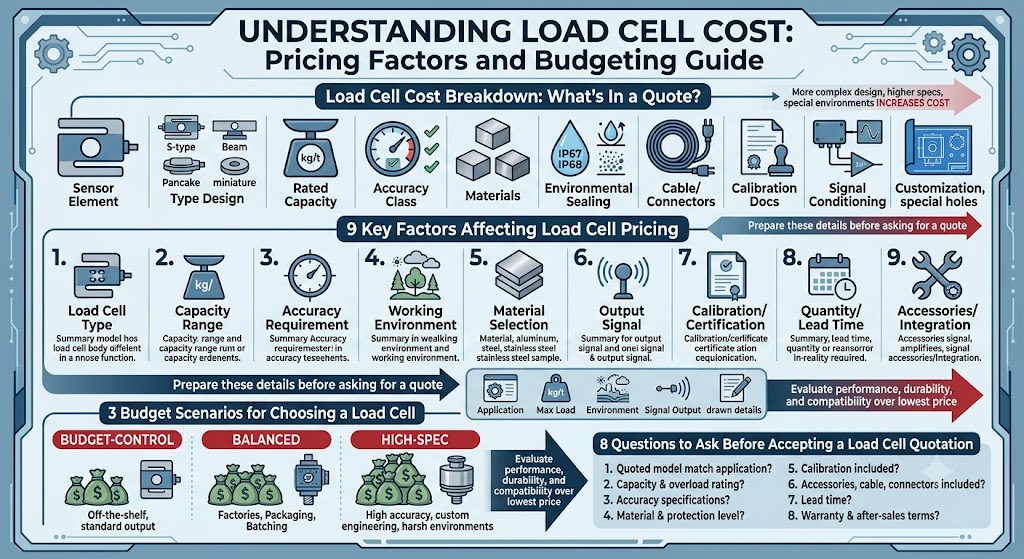
3 Budget Scenarios for Choosing a Load Cell
Budget-Control Option: Standard Model for Basic Measurement
This option is suitable when the application is straightforward, the environment is stable, and the measurement requirement is not extremely demanding. Examples include simple bench scales, basic force detection, educational testing, or non-critical weighing equipment. In this situation, an off-the-shelf load cell with standard output and basic calibration may be sufficient.
The main advantage is cost efficiency. However, buyers should still confirm capacity, overload protection, mounting method, and compatibility with the indicator or controller. Choosing the lowest-cost load cell without checking these details may lead to unstable readings or installation problems.
Balanced Option: Reliable Performance for Industrial Use
A balanced option is often the best choice for factories, weighing systems, packaging machines, batching systems, and automation equipment. This type of purchase focuses on stable performance, reasonable accuracy, durable materials, proper environmental protection, and clear documentation.
The price may be higher than an entry-level product, but it reduces the risk of downtime, inconsistent data, and repeated replacement. For most commercial and industrial users, this is usually the most practical direction because it balances cost, reliability, and long-term operation.
High-Spec Option: Precision, Harsh Environment, or Custom Engineering
A high-spec load cell is recommended when the application involves high accuracy, harsh environments, safety-critical equipment, special mechanical design, or regulated production processes. This may include food processing, chemical plants, heavy-duty testing, offshore equipment, lifting systems, or laboratory-grade measurement.
In this scenario, price should not be the only decision factor. The buyer should evaluate stability, protection level, material, certificate requirements, supplier engineering support, and after-sales service. A higher upfront cost may be justified if it prevents production loss, compliance issues, or measurement failure.
8 Questions to Ask Before Accepting a Load Cell Quotation
A load cell quotation should be reviewed carefully, especially when comparing multiple suppliers. These eight questions can help you avoid unclear pricing and technical mismatch.
- Does the quoted model match my application type? Confirm whether the load cell is suitable for weighing, compression, tension, force testing, tank weighing, or automation use.
- What capacity and safe overload rating are included? Make sure the rated capacity fits the maximum load and includes a reasonable safety margin.
- What accuracy specifications are provided? Ask for details such as linearity, repeatability, hysteresis, creep, and temperature effect when accuracy matters.
- What material and protection level are quoted? Verify whether the load cell body is aluminum, alloy steel, stainless steel, sealed, waterproof, or suitable for washdown areas.
- Is calibration included? Check whether the quote includes factory test data, calibration certificate, traceable calibration, or third-party documentation.
- Are cables, connectors, and accessories included? Cable length, connector type, mounting kits, indicators, and transmitters can change the total cost.
- What is the lead time? Standard models may ship faster, while customized load cells, high-capacity models, or special certifications may require longer production time.
- What are the warranty and after-sales terms? Ask how defects, installation problems, technical support, and replacement procedures are handled.
Common Quotation Risks and Purchasing Mistakes
Mistake 1: Comparing Only the Unit Price
A lower unit price may not include calibration, cable customization, connectors, installation accessories, or technical support. When comparing load cell prices, always compare the complete scope. A quote that looks more expensive may actually include more services and reduce future risk.
Mistake 2: Choosing Capacity Without Considering Real Load Conditions
Some buyers choose capacity based only on the expected weight. In real applications, impact load, vibration, uneven loading, overload, and mounting stress may affect sensor performance. A proper safety margin and mechanical design review are important.
Mistake 3: Ignoring Installation and Signal Compatibility
A load cell does not work alone. It must connect correctly with an amplifier, indicator, PLC, data acquisition system, or controller. If the output signal and wiring are not compatible, additional components may be needed, increasing the total project cost.
Mistake 4: Overlooking Environmental Conditions
Moisture, dust, outdoor exposure, chemical cleaning, and temperature variation can shorten service life if the load cell is not properly selected. For harsh environments, material and sealing level should be reviewed before purchase.
For a reliable load cell quotation, prepare your technical requirements in advance and request a clear breakdown. A professional supplier should be able to explain why a specific model, material, capacity, and accessory package is recommended. This makes it easier to compare options and choose a solution that fits both your budget and your application.
Load Cell FAQ
Q1: How much does a load cell cost?
Load cell cost depends on type, capacity, accuracy, material, protection level, calibration requirement, and accessories. A reliable quotation should clearly list what is included instead of showing only a unit price.
Q2: Are there hidden costs in a load cell quotation?
Hidden costs may appear when cable length, connectors, calibration certificates, mounting accessories, signal conditioners, or shipping are not clearly listed. Always ask the supplier to separate standard items and optional items.
Q3: How long does it take to deliver a load cell?
Delivery time depends on stock availability, capacity range, customization, quantity, and calibration requirements. Standard models are usually faster, while custom load cells or special documentation may require longer lead time.
Q4: What payment methods are commonly used for load cell orders?
Payment terms vary by supplier, order size, and customization level. Common arrangements include full payment before shipment, deposit with balance before delivery, or agreed business credit terms for established buyers.
Q5: Which load cell type should I choose?
The correct type depends on the application. Single point load cells are common for platform scales, shear beam load cells for industrial weighing, compression load cells for press or tank weighing, and S-type load cells for tension and compression testing.
Q6: Do I need a calibration certificate?
A calibration certificate is useful when measurement traceability, quality control, or compliance is required. For basic internal use, factory test data may be enough, but regulated applications often require more formal documentation.
Q7: Does higher capacity mean a better load cell?
Not necessarily. A load cell should match the actual measuring range. Choosing a capacity that is too high may reduce measurement resolution, while choosing one that is too low may increase overload risk.
Q8: Why do stainless steel load cells cost more?
Stainless steel load cells usually provide better corrosion resistance and are often used in washdown, outdoor, food processing, or chemical environments. The material and sealing requirements usually increase production cost.
Q9: Can a load cell be customized?
Yes. Common customization includes capacity, dimensions, cable length, connector type, output signal, mounting holes, sealing method, and private labeling. Customization may require a minimum order quantity or longer lead time.
Q10: How can I get an accurate load cell quote?
Prepare your application details, maximum load, expected accuracy, installation method, environment, output signal, quantity, delivery schedule, and certification needs. The more complete your information is, the more accurate the quotation will be.