


Pneumatic Grease Pump Guide: Uses, Benefits, Setup, and Selection Tips
What Is a Pneumatic Grease Pump?
A pneumatic grease pump is a grease dispensing system powered by compressed air. Instead of relying on hand pressure, the pump uses air pressure to move grease from a container, drum, pail, or reservoir through a hose and into a lubrication point. This makes it much easier to handle thick lubricants, especially in maintenance environments where grease must be applied frequently and consistently.
In simple terms, a pneumatic grease pump converts air energy into mechanical pumping force. When compressed air enters the pump, it drives an internal piston or reciprocating mechanism. This movement pushes grease through the outlet and into the delivery hose. Depending on the pump design, it may be used with grease guns, dispensing nozzles, metering valves, centralized lubrication systems, or direct lubrication lines.
Who Usually Uses a Pneumatic Grease Pump?
Pneumatic grease pumps are commonly used by automotive repair shops, truck maintenance centers, construction equipment service teams, agricultural machinery operators, factories, steel plants, manufacturing lines, and industrial maintenance departments. Any operation that needs repeatable grease application can benefit from a properly selected pump.
For example, a workshop servicing trucks may need to lubricate suspension parts, bearings, pins, bushings, joints, and other moving components. A factory may use grease pumps to maintain conveyors, motors, presses, gear mechanisms, and production machinery. In these environments, using a manual grease gun for every lubrication point can be slow and physically demanding.
What Makes It Different From a Manual Grease Gun?
A manual grease gun depends on human hand force. It is useful for small tasks, occasional lubrication, and portable maintenance work. A pneumatic grease pump, on the other hand, is designed for higher efficiency and heavier workloads. It reduces operator fatigue, improves output consistency, and supports longer hoses or centralized dispensing setups.
The main advantage is productivity. When a maintenance team needs to lubricate dozens or hundreds of points, pneumatic assistance can save significant time. It also helps maintain steadier grease flow, especially when working with high-viscosity grease that would be difficult to dispense manually.
Why Do Workshops and Factories Need a Pneumatic Grease Pump?
Lubrication is a basic but critical part of machine maintenance. Bearings, pins, bushings, chains, gears, slides, and moving joints all require proper lubrication to reduce friction and wear. When grease is applied too little, too late, or inconsistently, equipment may suffer from heat buildup, abnormal noise, vibration, premature wear, and unplanned downtime.
A pneumatic grease pump helps solve several practical problems at once. It improves grease delivery speed, supports heavier grease grades, reduces manual effort, and makes repeated lubrication work more manageable. In industrial environments, these benefits are not just about convenience; they can directly affect maintenance efficiency and equipment reliability.
1. It Reduces Manual Labor
Grease can be thick and difficult to move, especially in colder environments or when using high-viscosity products. Repeated manual pumping can quickly become tiring. A pneumatic grease pump allows compressed air to do the hard work, helping operators complete lubrication tasks with less physical strain.
2. It Improves Lubrication Efficiency
In busy maintenance environments, speed matters. A pneumatic grease pump can deliver grease faster than manual methods, especially when used with a proper hose, nozzle, and grease container setup. This is useful for fleet maintenance, production line service, and scheduled machine maintenance.
3. It Supports Consistent Grease Output
Manual greasing often depends on the operator’s hand force and technique. With pneumatic operation, grease flow can be more stable when the system is properly adjusted. This helps improve consistency, especially when multiple operators use the same lubrication system.
4. It Helps Handle Heavy-Duty Applications
Heavy equipment, agricultural machinery, construction machines, manufacturing systems, and large vehicles often require grease in many lubrication points. A pneumatic grease pump is better suited for these high-volume or frequent-use applications than a small manual tool.
How to Use a Pneumatic Grease Pump in 5 Steps
Using a pneumatic grease pump is not complicated, but correct setup is important. Poor installation, wrong air pressure, incompatible grease, or contaminated fittings can reduce performance and shorten equipment life. The following five-step process gives a practical overview for general use.
Step 1: Confirm Grease Compatibility
Before operation, confirm that the grease type matches the pump’s capability and the equipment requirement. Grease viscosity, base oil, thickener type, temperature range, and application environment all matter. A pump that works well with medium grease may not perform properly with extremely stiff grease.
Step 2: Install the Pump on the Grease Container
Many pneumatic grease pumps are mounted on a pail, drum, or grease reservoir. Make sure the follower plate, suction tube, drum cover, and pump body are correctly positioned. A poor seal or unstable mounting can lead to air pockets, inconsistent flow, or grease contamination.
Step 3: Connect the Air Supply Properly
Connect clean, dry compressed air to the pump. Use the recommended air pressure range from the pump manufacturer. Too little pressure may cause weak output, while excessive pressure may damage seals, hoses, or fittings. An air regulator and filter are strongly recommended for stable operation.
Step 4: Prime the Pump and Remove Air Pockets
Priming ensures that grease fills the pump chamber and hose before normal operation. Air trapped inside the system can cause sputtering, weak delivery, or unstable output. Run the pump slowly at first until grease flows smoothly from the dispensing point.
Step 5: Dispense Grease and Monitor Output
Once the pump is primed, connect the coupler, nozzle, or dispensing valve to the lubrication point. Apply grease steadily and avoid over-lubrication. Watch for abnormal resistance, leaking fittings, unusual pump noise, or inconsistent grease flow. These signs may indicate clogged lines, damaged seals, or incorrect setup.
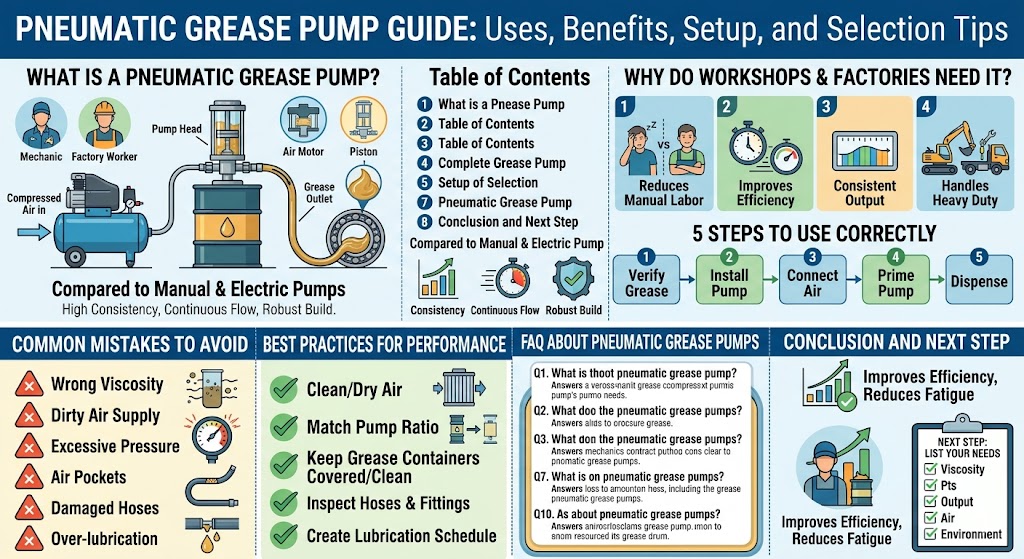
Pneumatic Grease Pump Comparison Table
| Item | Pneumatic Grease Pump | Manual Grease Gun | Electric Grease Pump |
|---|---|---|---|
| Power Source | Compressed air | Hand force | Electric motor or battery |
| Best For | Workshops, factories, heavy-duty lubrication | Small jobs and occasional use | Mobile maintenance or controlled dispensing |
| Output Efficiency | High and consistent when properly set up | Lower and operator-dependent | Stable, depending on motor and battery capacity |
| Operator Fatigue | Low | High during repeated use | Low |
| Maintenance Need | Air supply, seals, hose, and fittings | Basic cleaning and cartridge handling | Battery, motor, electronics, hose, and seals |
Common Pneumatic Grease Pump Mistakes to Avoid
A pneumatic grease pump can work reliably for a long time, but only when it is selected, installed, and maintained correctly. Many performance problems are not caused by the pump itself. They often come from unsuitable grease, poor air quality, incorrect pressure, contaminated fittings, or skipped maintenance.
- Using the wrong grease viscosity: Grease that is too stiff may cause weak output, priming issues, or excessive pump load.
- Running with dirty compressed air: Moisture and debris in the air supply can shorten seal life and affect pump performance.
- Setting air pressure too high: Excessive pressure can damage hoses, seals, couplers, or dispensing valves.
- Ignoring air pockets: Trapped air can cause unstable grease flow and poor lubrication results.
- Using damaged hoses: Cracked, kinked, or overloaded hoses can leak or burst under pressure.
- Over-lubricating equipment: More grease is not always better. Excess grease may attract dust, increase heat, or damage seals.
- Skipping regular inspection: Pump seals, fittings, follower plates, and air regulators should be checked regularly.
Best Practices for Better Grease Pump Performance
1. Use Clean and Dry Compressed Air
Air quality directly affects pneumatic tool performance. A filter-regulator setup helps remove moisture and particles while keeping the air pressure stable. This improves pump reliability and reduces unnecessary wear.
2. Match the Pump Ratio to the Application
Pneumatic grease pumps are often described by pressure ratio. The correct ratio depends on grease viscosity, hose length, lubrication point resistance, and dispensing requirements. Higher pressure is not automatically better. The right pump should deliver grease efficiently without stressing the system.
3. Keep Grease Containers Covered and Clean
Contaminated grease can damage bearings, seals, and moving parts. Always protect grease from dust, water, metal particles, and foreign material. A drum cover and follower plate can help reduce contamination and improve suction performance.
4. Inspect Hoses, Couplers, and Fittings Regularly
Grease systems work under pressure, so every connection matters. Worn couplers, cracked hoses, loose fittings, and damaged nozzles can cause leaks, pressure loss, and unsafe operation. Regular inspection helps prevent sudden failure.
5. Build a Lubrication Schedule
A pneumatic grease pump is most effective when used as part of a planned maintenance system. Record lubrication points, grease type, frequency, operating conditions, and inspection results. This reduces guesswork and helps maintenance teams avoid both under-lubrication and over-lubrication.
Conclusion and Next Step
A pneumatic grease pump is a practical solution for improving lubrication efficiency in workshops, factories, fleet maintenance centers, and heavy equipment service operations. By using compressed air to move grease, it reduces manual labor, supports repeated lubrication tasks, and helps deliver grease more consistently than manual tools.
The best results come from choosing the right pump for the grease type, application pressure, container size, hose length, and working environment. Correct setup is just as important as product selection. Clean compressed air, proper priming, regular inspection, and a clear lubrication schedule can all improve pump performance and extend service life.
Next step: Before selecting a pneumatic grease pump, list your grease type, lubrication points, required output, air supply conditions, and working environment. This makes it easier to compare models and choose a pump that fits real operating needs.
FAQ About Pneumatic Grease Pumps
Q1: What is a pneumatic grease pump used for?
A pneumatic grease pump is used to transfer and dispense grease into machinery, bearings, pins, bushings, joints, and other lubrication points. It is commonly used in automotive workshops, factories, heavy equipment service, agriculture, and industrial maintenance.
Q2: How does a pneumatic grease pump work?
It uses compressed air to drive an internal piston or pumping mechanism. This force pushes grease from a container through a hose and into the lubrication point. The result is faster and easier grease delivery compared with manual pumping.
Q3: Is a pneumatic grease pump better than a manual grease gun?
For frequent or heavy-duty lubrication, a pneumatic grease pump is usually more efficient. A manual grease gun is still useful for small jobs, field repairs, or occasional use, but pneumatic systems reduce hand fatigue and improve productivity.
Q4: What air pressure is needed for a pneumatic grease pump?
The required air pressure depends on the pump model and application. Users should follow the manufacturer’s recommended range and use an air regulator to prevent unstable output or damage caused by excessive pressure.
Q5: Can a pneumatic grease pump handle thick grease?
Many pneumatic grease pumps are designed for high-viscosity grease, but the actual capability depends on pump ratio, suction design, hose length, grease grade, and temperature. Always check compatibility before use.
Q6: Why does my pneumatic grease pump lose pressure?
Pressure loss may come from air leaks, worn seals, clogged hoses, loose fittings, trapped air, or grease that is too thick for the setup. Checking the air supply, hose condition, and pump seals is a good first step.
Q7: How do I maintain a pneumatic grease pump?
Keep the air supply clean and dry, inspect hoses and couplers, protect grease from contamination, check seals regularly, and follow the manufacturer’s maintenance schedule. Proper storage also helps extend pump life.
Q8: What causes air pockets in a grease pump?
Air pockets can form when grease is not packed properly, the pump is not primed, the follower plate does not seal well, or the container is changed incorrectly. Priming the pump slowly can help remove trapped air.
Q9: How do I choose the right pneumatic grease pump?
Start by checking grease type, required pressure, output volume, container size, hose length, operating environment, and available air supply. The right pump should match the real workload rather than only the highest pressure rating.
Q10: Is over-lubrication a problem with pneumatic grease pumps?
Yes. Because pneumatic pumps can dispense grease quickly, operators should avoid applying too much grease. Over-lubrication may attract contamination, create excess heat, damage seals, or cause grease waste.
延伸閱讀:
How to choose between Butterfly Valve and Ball Valve?