

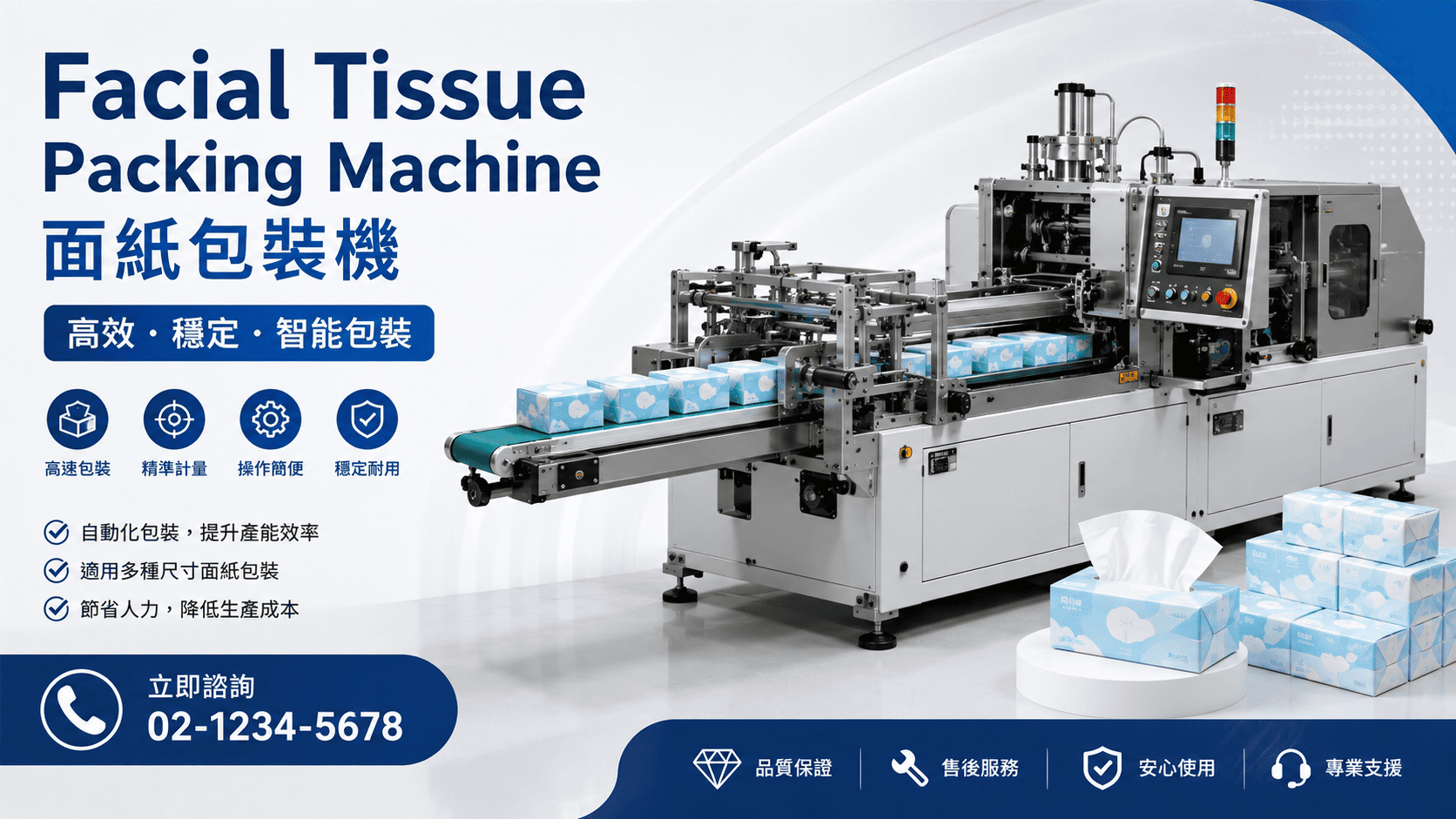
What Is a Facial Tissue Packing Machine? Types, Applications and Selection Guide
Introduction
A Facial Tissue Packing Machine is an essential piece of equipment in modern tissue manufacturing. It is used to package folded facial tissues into soft packs, boxes, or other retail-ready formats with consistent sealing, accurate counting, and stable output.
For tissue manufacturers, OEM factories, and private label production lines, choosing the right Tissue Packaging Machine can improve production efficiency, reduce labor dependency, and support stable product quality. The right Automatic Packing Machine should match the production capacity, packaging format, factory layout, and long-term maintenance requirements.
Table of Contents
- 1. What Is a Facial Tissue Packing Machine?
- 2. What Types of Facial Tissue Packing Machines Are Available?
- 3. What Are the Main Applications?
- 4. How to Choose the Right Facial Tissue Packing Machine?
- 5. What Factors Affect Machine Costs?
- 6. Maintenance and Operational Considerations
- 7. Future Trends in Tissue Packaging Equipment
- Conclusion
- FAQ
1. What Is a Facial Tissue Packing Machine?
How does a Facial Tissue Packing Machine work?
A Facial Tissue Packing Machine receives folded tissue stacks from the production line, positions them correctly, wraps or inserts them into packaging material, seals the package, and sends the finished product to the next process. Depending on the machine type, it may also include counting, conveying, coding, labeling, and inspection functions.
Why is automated tissue packaging important?
Automated tissue packaging helps reduce manual handling, improve packaging consistency, and increase output speed. In high-volume production, manual packaging can easily lead to inconsistent appearance, unstable efficiency, and higher labor costs.
What industries use tissue packaging equipment?
Tissue packaging equipment is widely used by household paper manufacturers, hygiene product factories, OEM suppliers, private label producers, supermarkets, hotel supply manufacturers, and export-oriented tissue production facilities.
How does packaging affect production efficiency?
Packaging affects not only product appearance but also line speed, storage efficiency, transportation stability, and brand presentation. A stable packaging process helps reduce downtime, product waste, and rework.
2. What Types of Facial Tissue Packing Machines Are Available?
Semi-automatic vs. fully automatic packing machines
Semi-automatic machines require more manual loading or handling, making them suitable for smaller production volumes or flexible product changes. Fully automatic machines can connect with upstream and downstream equipment, making them more suitable for large-scale production.
Soft pack tissue packaging machines
Soft pack tissue packaging machines are used for flexible film packaging. They are commonly used for household facial tissues, travel packs, and economical retail products. This format is lightweight, cost-effective, and convenient for transportation.
Box facial tissue packaging systems
Box facial tissue packaging systems are designed to insert folded tissues into paper boxes. They may include carton forming, tissue inserting, sealing, coding, and inspection. Box tissue products are common in homes, offices, hotels, and commercial spaces.
High-speed production line integration options
High-speed systems can be integrated with tissue folding machines, conveyors, cartoning machines, case packers, and palletizing systems. This allows manufacturers to build a complete Tissue Production Line with higher automation and lower manual intervention.
3. What Are the Main Applications?
Household tissue manufacturing
Facial tissue packing machines are widely used in household tissue production. They help manufacturers produce soft packs or boxed tissues with stable appearance and consistent quantity.
Commercial tissue product packaging
Commercial tissue products for offices, restaurants, hotels, clinics, and public facilities also require efficient packaging. Stable packaging improves storage, distribution, and product presentation.
OEM and private label tissue production
OEM and private label manufacturers often need to handle different brands, packaging designs, and product specifications. Flexible packing machines help them switch formats and support customized orders.
Export-oriented tissue manufacturing facilities
Export-focused factories need packaging that meets shipping, retail, and branding requirements. Automated packaging can improve consistency and reduce defects during large-volume production.
4. How to Choose the Right Facial Tissue Packing Machine?
Production capacity requirements
The first consideration is production capacity. Manufacturers should evaluate hourly output, daily production goals, shift schedules, and future expansion needs before selecting a machine.
Packaging format considerations
Different packaging formats require different machine designs. Soft packs, boxed tissues, multi-pack bundles, and customized packaging all require different feeding, wrapping, sealing, and output systems.
Automation level and labor efficiency
Higher automation can reduce labor needs and improve consistency, but it also requires a larger investment. Factories should evaluate labor cost, production stability, and long-term operating efficiency.
Machine durability and maintenance factors
Machine structure, component quality, control system stability, and spare parts availability all affect long-term performance. A durable machine can reduce downtime and maintenance costs.
5. What Factors Affect Machine Costs?
Machine speed and output volume
Higher-speed machines usually cost more because they require stronger structure, better control systems, and more precise operation. However, they may reduce unit production cost in large-scale manufacturing.
Customization requirements
Customized packaging sizes, special sealing methods, coding systems, inspection modules, or line integration requirements can increase machine cost.
Additional automation modules
Optional modules such as automatic feeding, labeling, checkweighing, carton packing, case packing, and robotic palletizing can improve efficiency but also raise the total investment.
Installation and training services
Installation, commissioning, operator training, and after-sales support may affect the total project cost. These services are important for stable production after delivery.
6. Maintenance and Operational Considerations
Preventive maintenance practices
Preventive maintenance includes regular cleaning, lubrication, inspection of sealing parts, sensor checks, belt adjustment, and control system monitoring. Routine maintenance helps reduce unexpected downtime.
Common troubleshooting issues
Common issues may include film misalignment, sealing failure, counting errors, unstable feeding, sensor malfunction, and conveyor jams. Operators should be trained to identify and solve basic issues quickly.
Spare parts management
Factories should keep essential spare parts such as belts, cutters, heating elements, sensors, bearings, and sealing components. Good spare parts management reduces repair delays.
Maximizing machine lifespan
Proper operation, regular maintenance, stable power supply, clean working conditions, and timely replacement of worn parts can help extend machine lifespan and maintain packaging quality.
7. Future Trends in Tissue Packaging Equipment
Smart factory integration
Modern tissue packaging equipment is increasingly connected to smart factory systems. Data collection, production monitoring, and remote diagnostics help manufacturers improve management efficiency.
Industry 4.0 applications
Industry 4.0 applications may include real-time output tracking, equipment status monitoring, predictive maintenance, and integration with factory management systems.
Sustainable packaging solutions
Sustainable packaging is becoming more important. Tissue manufacturers are exploring recyclable materials, reduced plastic use, and more efficient packaging designs to meet market expectations.
High-efficiency production developments
Future tissue packaging equipment will continue to move toward higher speed, lower energy consumption, easier format changeover, and more stable line integration.
Conclusion
A Facial Tissue Packing Machine plays a critical role in modern tissue manufacturing by improving packaging consistency, reducing labor costs, and increasing production efficiency. Selecting the right equipment requires evaluating production goals, packaging formats, automation requirements, and long-term operational costs.
FAQ
Q: What is a Facial Tissue Packing Machine?
A: It is a machine used to package folded facial tissues into soft packs, boxes, or other finished packaging formats.
Q: How does an automatic tissue packaging machine work?
A: It feeds tissue stacks, wraps or inserts them into packaging, seals the package, and transfers finished products to the next process.
Q: What production capacity should I choose?
A: The capacity should match your hourly output target, daily production volume, labor plan, and future expansion needs.
Q: What is the difference between soft pack and box tissue packaging?
A: Soft pack packaging uses flexible film, while box tissue packaging uses paper boxes and usually requires carton forming or tissue inserting systems.
Q: How often should the machine be maintained?
A: Maintenance frequency depends on production intensity, but daily cleaning and regular inspection are recommended.
Q: Can the machine be integrated into a complete production line?
A: Yes. It can be integrated with folding machines, conveyors, cartoners, case packers, and other Tissue Production Line equipment.